News & Infomation
Newsletters

APRIL 2007
 APRIL 2007
- Hanyang International appointed as designated intellectual property rights consultant to most populace province in South Korea: Gyeonggi province.
- Conditions under which functional expressions can be permitted and interpretation of the scope of a claim that includes such functional expressions: A recent Korean Patent Court case and the Revised Korean Patent Act.
- Patent issuance for inventions related to OLED on the big incline
- Recent updates on patent infringement cases.
- Patent trial decisions from Korean Intellectual Property Tribunal (KIPT) to be issued within 6 months
- International corporation, Starbucks, loses in a trademark invalidation trial.
- First geographical indication to be registered as a collective trademark in Korea, "JangHeung Mushroom."
Hanyang International appointed as designated intellectual property rights consultant to most populace province in South Korea: Gyeonggi province.
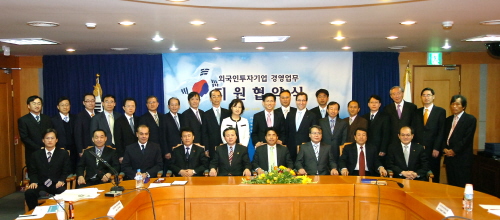
Seoul, the national capital, is located within the Gyeonggi province but it has been separately administered from the province since 1946. Gyeonggi province is the most populace province among the eight provinces in South Korea. Recently, Gyeonggi Province Government announced a plan to reinforce its capability to activate foreign capital inducement and improve investment environment. Accordingly, in its effort to promote inducement of foreign capital, the province entered into a joint convention with 18 entities. The entities covered expertise, such as general law, intellectual property law, accounting, and finance. Among the 18 entities, Hanyang International has been appointed as the designated intellectual property consultant to Gyeonggi province. Yeon-Soo Kim, managing partner of Hanyang International, attended the meeting on March 9, 2007 that was held to officially embark on the joint convention by Gyeonggi Province Government. Based on this new convention, any party planning to invest in Gyeonggi province is encouraged to consult with Hanyang International regarding intellectual property right related issues. Hanyang International has agreed to provide such consultation to potential investors at free of charge, subject only to time limitation according to the convention. More information on Gyeonggi Province Government can be found on:http://english.gg.go.kr/
Conditions under which functional expressions can be permitted and interpretation of the scope of a claim that includes such functional expressions: A recent Korean Patent Court case and the Revised Korean Patent Act.
The Korean Patent Court held that: “[a] functional expression is permitted in a claim only when the invention can be considered as being clear on the whole even with such expression. The claims are permissible in cases, such as when the claim needs to be recited with a functional expression due to difficulty of clearly pointing out the technical idea of an invention just with the conventional technical structures, and when a meaning or substance of functional expression can be clearly and definitely confirmed based on the specification and the drawings. Furthermore, the scope of the claim with a functional expression shall not be interpreted to include all the structures that can perform such a function, but shall be interpreted limitedly to include only the structure(s) that can be clearly and definitely confirmed by the specification and the drawings”.
In order to satisfy the description requirements for the functional expression recited in a claim under the Korean patent practice, the specific structures that can realize such a function should be described in the specification and/or drawings. However, the latter part of the court’s opinion concerning the interpretation of claims with functional expressions may be controversial in that, upon determining the novelty or the inventiveness issue, according to the current Korean patent practice including the precedents of the Korean Supreme Court, the scope of a claim is determined based on the description in the claim unless the description itself is deemed unclear.
[Revised Korean Patent Act, effective as of July 1, 2007, regarding claim drafting]
The current claim description requirement, “a claim must define only the features indispensable for the construction of the invention,” will be changed to “a claim must define a structure, method, function, substance, or a combination thereof that is necessary to specify the invention in order to clarify the subject matter to be protected.” Thus, a claim with functional expressions will be basically permitted under the revised Korean Patent Law.
However, since another claim description requirement, “a claim must define the invention clearly and concisely,” is still effective, a claim with a functional expression will not be permitted if the claim fails to define the invention clearly and concisely as a result of such a functional expressions. Also, although a claim is registered as a patent with such unclear functional expression, the scope of the claim will be limitedly interpreted based on the specification and the drawings.
Patent issuance for inventions related to OLED on the big incline
The Korean Intellectual Property Office (KIPO) stated that filings on patent registrations related to OLED technology showed an increase rate of 108.7%, 232.0%, and 79.0% in the manufacturing processes and devices, driving circuits, and light emitting elements, respectively, from 2000 to 2006. In particular, in 2005, corporations registered 279 patents, which was 2.3 times more than 2004. Furthermore, in 2006, corporations registered 1,318 patents making it 4.7 times more than 2005.
The OLED shows a high quality in brightness, color purity, and viewing angle, especially the response time is only a few microseconds, whereby allowing the image quality in the motion picture to be better than that of the LCD. The currently mass-produced 2.4 inch AM-OLED is expected to be sold at a three to four times more expensive price compared to the LCD with the same specifications. However, the new trend is that OLED is to be applied to high quality specifications for portable devices, such as cellular phones, MP3s, and DMBs, because the image quality is enhanced compared to the LCD.
Recent updates on patent infringement cases.
Tonen Chemical Corporation, a subsidiary of Exxon Mobil Japan Group, filed an infringement suit with the Seoul Central District Court against SK Corporation in March 2006 alleging that SK infringed its Korean patent and trade secret rights regarding LiBS (Lithium Ion Battery Separator). The Seoul Central District Court ruled in favor of SK Corporation on January 11, 2007 and held that SK Corporation did not infringe Tonen’s Korean patent and trade secret rights.
SK Corporation developed LiBS in December 2004, based on its own technology, first in Korea and third in the world and established a mass-production system. SK has been mass-producing it since December 2005. According to the decision in the infringement suit above, SK Corporation is expected to increase the production of LiBS and it looks highly likely that Korean secondary battery producers could overcome their dependency on imported LiBS. .
In the meantime, SK Corporation filed a suit against TONEN CHEMICAL CORPORATION with Fair Trade Commission in December 2006, alleging that TONEN has intentionally raised the infringement suit, thereby impeding fair trade by way of delaying the market entry of other companies. .
(2) Pfizer Inc. vs. Ahn-Gook Pharm. Co.,Ltd.
Ahn-Gook Pharm. requested a trial to confirm the scope of the patent, KR91020, which relates to NORVASC® (amlodipine besylate), on July 11, 2006, alleging that its invention does not fall within the scope of KR91020. On February 28, 2007, theKorean Intellectual Property Tribunal (KIPT) rejected the request, which means that KIPT took the position that LEVOTENSION (S-amlodipine besylate) of Ahn-gook Pham. infringes Pfizer’s patent.
Following KIPT’s decision, the Seoul Southern District Court entered a provisional disposition in favor of Pfeizer’s request made last year, and prohibited Ahn-Gook Pharm. from activities, such as manufacturing, using, assigning, leasing, importing of Levotension, on a condition that Pfizer place five million KRW as bond deposit. As a result, Ahn-Gook Pharm. stopped the product sales and filed a request for suspension of the provisional disposition and also an opposition against the provisional disposition with the Seoul Southern District Court on March 13, 2007. In the meantime, on August 6, 2005, Ahn-Gook Pharm filed an invalidation trial of Pfeizer’s patent regarding NORVASC® (amlodipine besylate), KR91020, which was rejected by KIPT on July 25, 2006. In response, the applicant filed an appeal to the Patent Court on August 23, 2006.
Patent trial decisions from Korean Intellectual Property Tribunal (KIPT) to be issued within 6 months
To drastically expedite the issuance of patent trial decisions in order to keep up with patent trials at KIPT that have been increasing rapidly recently, the Korean Intellectual Property Office (KIPO) is planning to reduce the decision processing time at KIPT from a period of 14 months in 2003 to 6 months by the end of 2007. To reach this goal, KIPO will increase the number of trial examiners and make innovative improvements to the trial processing policy.
KIPO increased the number of trial examiners by 30 in 2006, and it plans to boost this number by a further 24 in 2007, which will results in a total of 103 trial examiners. The innovative improvements to the trial processing policy include an application of the “intensive trial procedure” to all inter partes cases, a restriction on extending the period for submitting an answer, and allowing oral notices on schedules for trial completion.
According to the intensive trial procedure, the arguments and evidence from both parties are submitted altogether, thereby enabling the main issues and evidence to be sorted out at an early stage for a swift judgment. This procedure was partially introduced in January of 2006 in some cases. According to this procedure, a single round of pleadings are exchanged between both parties followed by an oral hearing, thereby allowing main issues to be sorted out at an early stage. Also, through an oral hearing, the assertions from both parties can be fully heard, enhancing the quality and fairness of the judgments.
International corporation, Starbucks, loses in a trademark invalidation trial.
The Korean Supreme Court held in said invalidation trial that upon determining similarity between the two marks, the fact that both marks have its trade name, wordings, such as “coffee,” or a star design within two circles is insignificant because such characteristics are commonly found in the coffee franchise industry. Thus, such characteristics cannot be the focus in determination of similarity between the marks. Furthermore, the Court held that “Starpreya” and “Starbucks” are not confusingly similar in wording, and also, the mermaid design in the Starbucks logo and the goddess design in the Starpreya logo cannot be deemed similar.
The Supreme Court also stated that the trademark and service mark for Starbucks and Starpreya are not similar in terms of appearance and pronunciation when viewed in their entireties. Furthermore, the composition and motif underlying the marks are not related to the extent that they would bring about confusion. In affirming the lower court’s decision, the Supreme Court also stated that Starbucks’s mark was not well-renowned in Korea even until the time Starpreya’s trademark application was filed, based on the duration of sales activities and advertisement method and amount by way of using the Starbucks mark.
In this case, if Starbucks had registered its mark in color, perhaps, its argument in the invalidation trial could have carried more weight in the issue of similarity. Also, it is to be noted that there was no argument regarding how Starpreya’s mark is actually being used in the market compared to what was, in fact, registered. Based on such a theory, Starbucks could have proceeded with cancellation against the Starpreya’s mark simultaneous with the invalidation trial.
First geographical indication to be registered as a collective trademark in Korea, "JangHeung Mushroom."
In 2005, the Korean Trademark Act was revised to protect goods with a specific geographical indication, which consists of the name of a place of a good’s origin, in order to proactively correspond to the reinforcement in protection of geographical indication by DDA (Doha Development Agenda) and FTA (Free Trade Agreement). According to the new Act, if a legal entity, which consists of manufacturers and/or processors of products using such indications, files a collective mark application for the geographical indication, it can be registered after examination.
In the case when a third party imitates and uses a mark similar to “JangHeung Mushroom,” the registrant of “JangHeung Mushroom” is able to request compensation for damages and/or file a complaint against the third party on the basis of the JangHeung Mushroom’s collective mark registration.
Because not only well-known foreign geographical indications but also domestically renowned local goods with a specific geographical origin are to be protected as collective marks, such applications are expected to be filed increasingly with the Korean Intellectual Property Office.