News & Infomation
简报

October 2015
 October 2015
Claims with numerical limitation are unenforceable, if enablement of the entire range of such numerical limitation recited in the claims is not fully described in its specification (the Korean Supreme Court, decision rendered on September 24, 2015, Case No. 2013 Hu 518).
I. Summary of the Decision
On September 24, 2015, the Korean Supreme Court ruled that the scope of the rights to the accused product is not within that of the subject invention, even without any need for comparison of the subject patent with the accused product, holding that the claims of the subject invention with numerical limitation are unenforceable since enablement of the entire range of such numerical limitation in the subject patent was not fully described in its specification (the Korean Supreme Court, decision on September 24, 2015, Case No. 2013 Hu 518).
II. Case History
(A) A Confirmation Trial on the Scope of the Rights and a Decision
On May 26, 2011, the patentee of the subject patent (Korean Patent No. 10-0566449, hereinafter, “the ’449 patent”) filed a Confirmation Trial on the Scope of the Rights (hereinafter, “the Confirmation Trial”) against the alleged patent infringer with the Korean Intellectual Property Trial and Appeal Board (hereinafter, “the KIPTAB”), contending that the accused product enabled by the alleged infringer is within the scope of the patentee’s patent rights to the ’449 patent, since the product and the technical features are identical to those of claim 1 in the ’449 patent.
(* A Confirmation Trial is a unique proceeding under the Korean Patent Act, and this is a trial brought in to verify the valid scope of protection for the registered patent. The patentee can designate either the product or the method of a third party as a subject of the Confirmation Trial, seeking the decision that “the accused product is within the scope of the patent rights owned by him/her, the patentee.” On the other hand, a third party can designate his/her own product or method as a subject of the Confirmation Trial, seeking the decision that “the subject for the Confirmation Trial is not within the scope of the patent rights owned by the patentee.” A Litigation for Cancellation of the Trial Decision can be filed to the Korean Patent Court as an appeal from the decision at the Confirmation Trial, and another appeal from the decision at the Korean Patent Court can be heard at the Koran Supreme Court. There is no compulsory execution against the infringing product by the decision at the Confirmation Trial. However, it is one of the most-used measures taken in patent infringement disputes in Korea since it is fast and economical compared to the patent infringement lawsuits, and it can usually be considered as strong proof of evidence).
The invention of claim 1 of the ’449 patent is directed to “a film roll of a heat-shrinkable polyester” comprising numerical limitations for the property deviation as follows: “the heat shrinkage percentages in the maximum shrinkage direction” (hereinafter, “Feature 1”); “the content of the primary sub constitutional unit” (hereinafter, “Feature 2”); and “the heat shrinkage percentages in the direction perpendicular to the maximum shrinkage direction” (hereinafter, “Feature 3”). Please refer to the following table for the numerical limitations specified in the embodiments of the ’449 patent and the accused product.
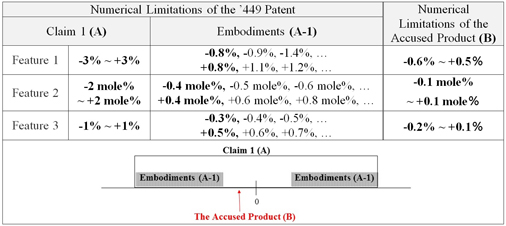
- (A): The numerical limitation for the property deviation (Features 1-3) of claim 1 in the ’449 Patent is specified as “within “±3%; ±2 mole%; and ±1%,” respectively, for their upper limits only, but without the lower limits.
- (A-1): The numerical limitation specified for the embodiments of the ’449 Patent stands for a minimum property deviation for the Features 1-3, as “-0.8%, +0.8%; -0.4 mole%, +0.4 mole%; and -0.3%, +0.5%,” respectively.
- (B): The numerical limitation specified for the accused product is within the ranges of “-0.6% ~ +0.5%; -0.1 mole% ~ +0.1 mole%; and -0.2% ~ +0.1%,” respectively, and such ranges are narrower than the minimum property deviation described in the embodiments of the ’449 Patent.
With regard to the foregoing, the alleged infringer asserted that the accused product shall not be deemed valid within the scope of the rights to the ’449 Patent since the novelty of the invention in claim 1 of the ’449 Patent is not acknowledged due to the prior art of “a heat-shrinkable polyester film” disclosed in the Japanese Patent Publication No. H07-205283. However, the KIPTAB ruled against the alleged infringer, finding that the subject patent is valid and the accused product is within the scope of the rights to the ’449 Patent (decision rendered on June 26, 2012, Case No. 2011 Dang 1183).
(B) Decision by the Korean Patent Court
The alleged infringer initiated a Litigation for Cancellation of the Trial Decision to the Korean Patent Court against the decision rendered by the KIPTAB. The alleged infringer contended that the enablement of “the film role with the property deviation of 0% in its average” recited in claim 1 of the ’449 Patent is not practically possible, rendering its recitation of the claim unclear. However, the Korean Patent Court found that the accused product is within the scope of the patent rights to the ’449 Patent, reasoning that: (1) claim 1 with technically non-enabled numerical limitation is not deemed unclear for its recitation of the claim, since the claimed scope of claim 1 has technical significance only for the technically enabled ranges within such numerical limitation; and (2) interpretation of the numerical limitation recited in claim 1 cannot be limited only to the embodiments of the ’449 Patent (decision rendered on January 25, 2013, Case No. 2012 Heo 6700).
(C) Decision by the Korean Supreme Court
The Appellant (the alleged infringer) filed an appeal to the Korean Supreme Court, and the Korean Supreme Court reversed the decision of the Korean Patent Court, holding that the accused product is not within the scope of the patent rights to the subject patent, even without any need for comparison of the accused product with the ’449 Patent. The Korean Supreme Court reasoned that the claims of the ’449 Patent are unenforceable because of the deficiency in description requirements under Article 42(3) of the Korean Patent Act, as enablement of the entire range of the numerical limitation was not fully described in the specification of the ’449 Patent.
III. Reasoning behind this Decision by the Korean Supreme Court
(A) Enablement Requirements for the Invention with Numerical Limitation
In line with the description requirements set out in Article 42(3) of the Korean Patent Act, the Korean Supreme Court held that the objectives, the specific features, and the expected effects of the invention shall be sufficiently described in the specification such that a person having ordinary skill in the art enables the invention over its entire rangeof the numerical limitationrecited in the claims without any unduly repeated experiments or special knowledge, but only with the description in the specification. However, the Korean Supreme Court noted that the embodiments illustrating enablement of the invention for its entire range of the numerical limitation recited in the claims are not required under the same provision of the Korean Patent Act.
(B) Specification of the ’449 Patent and its Deficiency in Description Requirements
The Korean Supreme Court ruled that the specification of the ’449 Patent is deficient in description requirements under Article 42(3) of the Koran Patent Act, since the product according to the ’449 Patent cannot be produced over the entire range of the numerical limitation recited in the claims. More specifically, the Court found as follows:
(1) The property deviation specified or expected in the embodiments of the ’449 Patent represents only part of the ranges (“A-1” in the above table) of the numerical limitation recited in claim 1. The ranges which are narrower than those specified or expected in the embodiments are not described (i.e., no embodiments are specified for the above-listed Features 1-3: -0.8% ~ +0.8% (Feature 1); -0.4 mole% ~ +0.4 mole% (Feature 2); and -0.3% ~ +0.5% (Feature 3));
(2) In its detailed description of the specification of the ’449 Patent, there is no description or suggestion for obtaining the property deviation in the numerical ranges specified in the accused product, and these ranges of the accused product are narrower than those of the embodiments of the ’449 Patent; and
(3) The Korean Supreme Court held that the property deviation in the numerical ranges narrower than those for the embodiments cannot be obtained based only upon the description of the specification, since the embodiment #9, wherein the more strict manufacturing requirements (a surface temperature of the film, control for a more uniform composition…etc.) are applied than those for the embodiment #7, shows bigger absolute values.
(C) The scope of the patent rights to the invention with numerical limitation
“If an invention cannot be specified for its technical scopes sought for protection due to the abstract or unclear description/recitation of the invention in its specification/claims, its claims are unenforceable (the Korean Supreme Court, decision on June 14, 2002, Case No. 2000 Hu 235; decision on December 27, 2001, Case No. 99 Hu 1973).” Based upon the foregoing, the Korean Supreme Court held that the scope of the rights to the accused product is not within that of the ’449 Patent, even without any need for comparison of the ’449 Patent with the accused product, since the technical scopes sought for protection in the invention with numerical limitation for the ’449 Patent cannot be specified due to the deficiency in the description requirements set out under Article 42(3) of the Korean Patent Act.
IV. Significance of this Decision by the Korean Supreme Court
The Korean Supreme Court held that the claims of the ’449 Patent are unenforceable against the accused product for the numerical ranges which are not enabled based only upon the description in the specification (the numerical ranges outside the ranges for the embodiments). Especially, the Court held that the claim scopes are not limited only to the numerically enabled ranges of the numerical limitation; rather, the Court clearly held that the entire claims are unenforceable, in this case.
Therefore, according to the decision rendered by the Korean Supreme Court, if an invention contains numerical ranges which are not enabled only with the description in the specification, (1) the specification is deemed deficient in the description requirements under the Korean Patent Act; (2) without invalidation of the subject patent, the entire claims are unenforceable; (3) thus, the patentee is not entitled also to the patent rights against the third party who enables the invention with the numerical ranges which are enabled in the patentee’s patent (please note that the patentee can limit the numerical ranges only to the enabled ranges, pursuant to the requirements for the Trial for Correction).
It became clear by this decision of the Korean Supreme Court that the technical effects should be obtained based only upon the description in the specification, over the entire range of the numerical limitation. More specifically, in filing of the invention with numerical limitation, the following strategies need to be considered: (1) it is desirable to specify as various embodiments as possible in the specification to support the entire range of the numerical limitation; (2) any bases supporting that the technical effects expected from the numerical ranges which have not been included in the embodiments are identical to those obtainable from the embodiments should be specified in the specification; (3) in order for a broad scope of the rights to the claims and a coverage over the respective embodiment, narrower numerical ranges in a multi-phase should be recited in the dependent claims; and (4) an independent claim may be desirable for an obvious numerical range for enablement of the invention.